
AI and Wearables: The Next Frontier for Tech Expansion in Healthcare
Last updated on August 26th, 2026 at 03:18 am
The integration of AI and wearables is fundamentally reshaping the medical landscape, offering a proactive response to the complexities of modern patient care. As global demand for accessible services increases, the synergy between AI and wearables provides a sophisticated bridge between raw data and actionable health insights.
While traditional systems face significant strain, these digital tools offer unparalleled opportunities for innovation. By leveraging the predictive power of AI and wearables, the industry is shifting from reactive treatment to a personalized, preventative model.
This evolution ensures that the future of healthcare is not only more efficient but also more human-centric.
Contents
The Future is Now: Revolutionary Healthcare Innovations
Innovation In Healthcare
Healthcare innovation constantly pushes the boundaries of what is possible, resulting in improved health outcomes, better patient experiences, and increased efficiency in healthcare delivery. From the development of new medical technologies to the implementation of innovative approaches to care, healthcare innovation can revolutionize the industry and transform patients’ lives.
⚡ Healthcare Innovation: At a Glance
Breaking distance barriers with 24/7 virtual specialist access.
Using algorithms to predict health risks before symptoms appear.
Turning smartphones into medical-grade BP & vitals trackers.
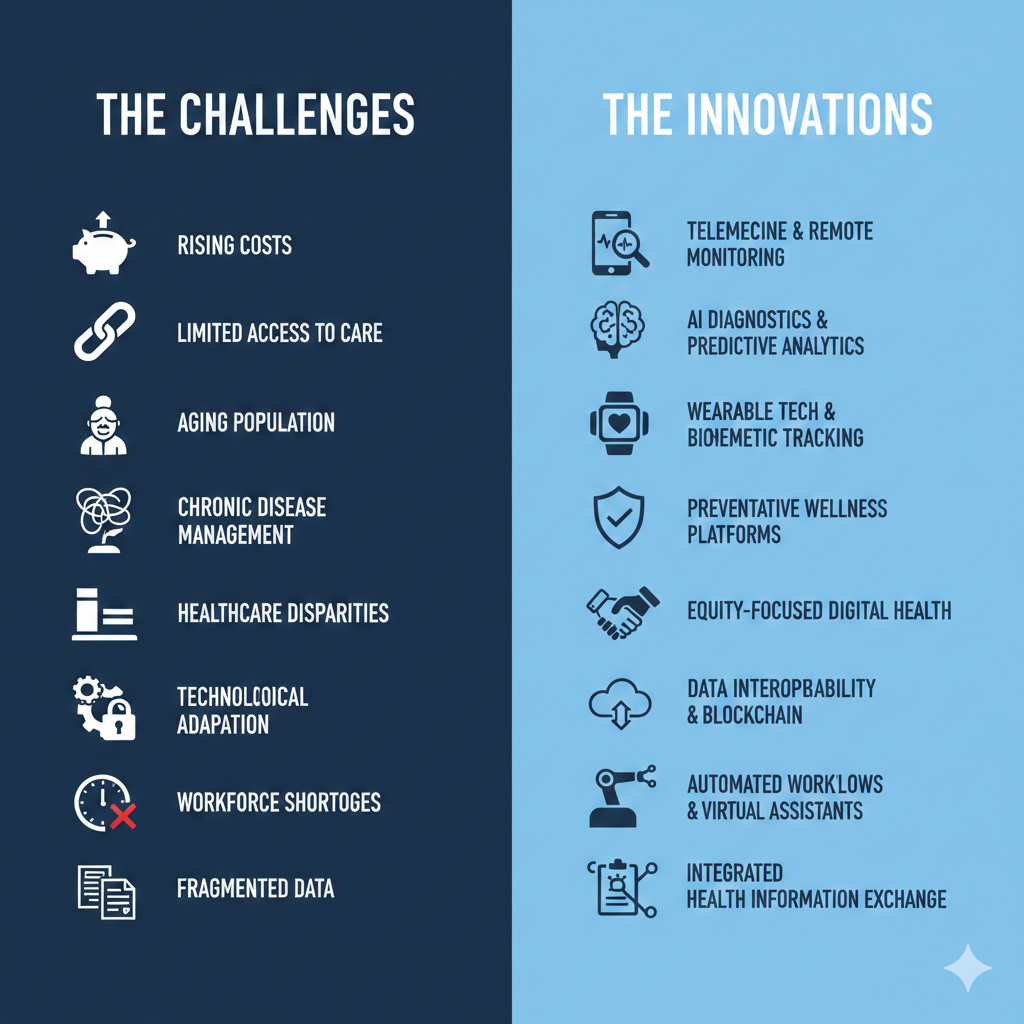
Healthcare Innovation: Addressing Challenges with Creative Solutions
Click each heading to explore the specific challenges currently facing the global healthcare landscape and the paths toward innovation.
📈 Rising Costs
Healthcare costs continue to escalate, straining individuals, families, and healthcare systems. Factors such as expensive medical treatments, technological advancements, and an aging population contribute to the rising costs.
📍 Access to Care
Many individuals struggle to access quality services, especially in underserved or rural areas. Limited providers, long wait times, and inadequate insurance coverage remain significant barriers to timely care.
🧓 Aging Population
An aging demographic increases demand for specialized services, chronic disease management, and long-term care. Systems must adapt to meet these unique needs to ensure quality of life for older adults.
💊 Chronic Disease Management
With conditions like diabetes, heart disease, and obesity on the rise, healthcare providers must focus on ongoing care coordination, patient education, and lifestyle modifications to prevent complications.
⚖️ Healthcare Disparities
Disparities persist across racial and ethnic groups, low-income individuals, and marginalized communities. Addressing these is crucial for achieving equitable and inclusive healthcare.
- Statistical Fact: In the US, Black women are 3x more likely to die from pregnancy-related causes than White women.
- Health Literacy: Roughly 14% of the US population lacks the health literacy necessary to navigate the system effectively.
💻 Technological Adaptation
Organizations must adapt to rapidly evolving digital tools, ensure data privacy, and integrate technology effectively to enhance clinical workflows without compromising patient security.
👨⚕️ Workforce Shortages
Shortages of physicians and nurses lead to increased workloads and burnout. By 2034, the US may face a shortage of up to 124,000 physicians, severely impacting patient care capacity.
🔄 Health Information Exchange
Fragmented health records and interoperability issues hinder efficient communication, care coordination, and patient safety.
AI and Wearables: Solutions for Complex Health Challenges
The healthcare industry faces numerous challenges that require innovative solutions, including rising costs, access barriers, and evolving patient needs. Here's how AI and wearables are transforming the landscape.
📞 Telemedicine and Virtual Care
Telemedicine and virtual care are powerful tools for expanding healthcare access and improving patient outcomes. They enable remote consultations, virtual visits, and remote monitoring, allowing timely medical attention without in-person visits. These technologies are vital in rural areas or during crises that limit physical access.
📱 Virtual Care⌚ Wearable Technology and Remote Monitoring
Wearable devices like smartwatches and fitness trackers empower individuals to control their health. They monitor vital signs and activity, providing real-time feedback. Remote monitoring allows providers to monitor chronic conditions remotely, intervening when necessary, reducing readmissions, and improving outcomes.
⌚ Remote Monitoring🧠 Artificial Intelligence in Healthcare
Artificial Intelligence (AI) revolutionizes healthcare by enhancing diagnostic accuracy, predicting disease outcomes, and optimizing treatment plans. AI algorithms analyze vast patient data to identify patterns and provide valuable insights to healthcare professionals across radiology, image recognition, and predictive analytics for disease management.
🧠 AI Diagnostics🧬 Precision Medicine
Precision medicine tailors medical treatments by considering an individual's genetic makeup, lifestyle, and environment. Analyzing genetic data and leveraging advanced technologies allows personalized treatment plans, leading to more effective outcomes and minimized adverse reactions.
🧬 Personalized Care🔗 Blockchain in Healthcare
Blockchain technology enables secure, transparent data management in healthcare. It enables secure sharing of medical records, protects patient privacy, and efficiently manages healthcare transactions by eliminating intermediaries and enhancing data integrity. Thus, it could potentially revolutionize healthcare data management and streamline processes.
🔗 Secure Data💡 The Path Forward
Innovation is critical to addressing healthcare challenges. Embracing technologies like telemedicine, AI, wearable devices, precision medicine, and blockchain enhances patient care, improves outcomes, and optimizes healthcare delivery, paving the way for a more accessible, efficient, and patient-centric system.
How to Implement AI and Wearable Healthcare Solutions
Implementing new healthcare solutions can be challenging, but with the right approach, you can unlock the full potential of wearable tech for clinical trials and forge preventive healthcare technology partnerships that drive real impact.
🤝 Involve Stakeholders
Engage healthcare providers, patients, and community members in developing and implementing new solutions. In Latin America, successful healthtech projects often begin with local partnerships—Colombia's Telepatia partnered with local clinics to deploy AI clinical assistants addressing the region's shortage of 1.9 million doctors.
Key to preventive healthcare technology partnerships: Co-creation with local stakeholders ensures solutions are culturally appropriate and address real needs.
🤝 Partnership Focus🔬 Start Small – Pilot Programs
Test the effectiveness and feasibility of new solutions with a pilot program or small-scale implementation. Brazil's LataMed AI successfully launched school-based telemedicine programs in Caracas, connecting students and families with online consultations, before expanding regionally.
For wearable tech for clinical trials, smartwatch-based 9-lead ECGs are now being validated in pilot studies for diagnosing heart attacks in emergency settings. These smaller studies provide critical data for broader adoption.
🔬 Pilot First📊 Monitor Outcomes
Continuously monitor and evaluate the impact of new solutions to identify areas for improvement. Biospectal's OptiBP app uses large-scale data collection to aid drug development and public health strategies. In Mexico, wearables in pharma are projected to grow from $44.4M (2026) to $96.2M by 2031, driven by continuous outcome monitoring.
Real-time remote patient monitoring shortens the feedback loop between patient data and clinical action, enabling rapid course correction and improved outcomes.
📊 Data-Driven💰 Seek Funding & Partnerships
Identify funding opportunities and partnerships to support development and implementation. Brazil's healthtech investments surpassed R$ 2 billion in 2024, with over 1,200 active healthtechs—a 35% increase since 2020. The market could exceed R$ 5 billion annually by 2028.
Governments are also investing: Colombia is building a national health interoperability platform expected to process approximately 400 million FHIR documents per year, creating opportunities for preventive healthcare technology partnerships.
💰 Investment Ready🧠 Expert Opinion: The Future of Frictionless Monitoring
"The integration of technologies like Biospectal OptiBP represents the 'Holy Grail' of chronic disease management: frictionless data collection. By removing the physical barrier of the blood pressure cuff, we remove the psychological barrier of 'white coat hypertension' and patient non-compliance. When monitoring becomes as simple as taking a selfie, we move from snapshot medicine to continuous, actionable health data. This is how we finally get ahead of the 'silent killer.'"
— Wellness & Innovation Analyst, PraktikoTips
📚 Related Resources
Explore how wearable tech for clinical trials and preventive healthcare technology partnerships are shaping the future of healthtech.
The $39 Billion Opportunity: How AI and Wearables Are Revolutionizing Healthcare in Latin America (2026 Guide)
For tech companies, Latin America represents a massive and largely untapped market for healthcare innovation. The convergence of AI and wearables is creating a multi-billion-dollar opportunity driven by a pressing need for accessible, preventive care.
Mexico's wearables in pharma and biotech market alone was valued at $44.4 million in 2026, projected to reach $96.2 million by 2031.
Meanwhile, Brazil saw healthtech investments surpass R$ 2 billion in 2024, with over 1,200 active healthtechs [citation:3].
🧠 AI-Powered Diagnostics & Clinical Support
AI is transforming healthcare delivery across Latin America. Colombian startup Telepatia, backed by Andreessen Horowitz, is deploying AI clinical assistants to help address the region's shortage of 1.9 million doctors .
The platform transcribes consultations, reviews patient records, and provides real-time clinical recommendations.
In Colombia, researchers at the Central Military Hospital in Bogotá developed AI models using neural networks and random forests to estimate cardiovascular risk with high accuracy.
Chile's FALP foundation validated an AI-powered biopsy platform achieving 100% technical compliance with international interoperability standards.
⌚ Wearables & Remote Monitoring
Wearable devices are advancing remote patient monitoring across the region. Mexican researchers from the Universidad Veracruzana patented a mobile cardiac monitor that tracks blood pressure, glucose, and ECG, sending automatic alerts to medical staff via.
The Universidad Panamericana developed a non-contact pulse oximeter using standard smartphone cameras to measure oxygen saturation remotely.
A clinical trial is currently validating smartwatch-based 9-lead ECGs for diagnosing heart attacks in emergency settings, building on previous research showing high sensitivity and specificity.
Mexico's wearables market is projected to grow at a 16.7% CAGR through 2031.
📱 Telemedicine & Digital Health Access
Digital health is expanding access to care across Latin America. LataMed AI is implementing school-based telemedicine programs in Caracas, connecting students, families, and school personnel with online medical consultations [citation:10]. Brazil's federal government plans to invest R$ 4.5 billion through 2026 in a network of "intelligent hospitals" and 14 interconnected smart ICUs, with an additional R$ 133 million allocated to digital health initiatives.
Colombia is building a national health interoperability platform that is expected to process approximately 400 million FHIR documents per year, enabling seamless clinical data exchange across 9,000 healthcare providers [citation:15]. Over 50 health IT vendors have already adapted their systems to support FHIR-based exchange .
📊 30M+ telemedicine visits in Brazil (2024)📋 Regulatory Modernization & Investment
Countries across Latin America are rapidly modernizing healthcare regulations to foster innovation. Brazil, Mexico, and Ecuador are accelerating approvals for decentralized clinical trials and digital health solutions.
Brazil's R$ 2.1 billion in healthtech investments in 2024 represents an 18% growth from 2023, with over 1,200 active healthtechs—a 35% increase since 2020. The market could exceed R$ 5 billion annually by 2028.
Colombia's adoption of HL7 FHIR for national interoperability under Law 2015 of 2020 represents a structural shift toward standards-based healthcare, laying the foundation for future cross-border data exchange . This regulatory momentum creates clear entry points for technology providers and investors.
📊 R$ 5B projected by 2028 in Brazil💡 The Opportunity Formula
AI Diagnostics + Wearable Monitoring + Telemedicine Infrastructure + Regulatory Support = Unmatched Market Potential.
Healthcare Innovation: At a Glance
Breaking distance barriers with 24/7 virtual specialist access.
🏥 AccessUsing algorithms to predict health risks before symptoms appear.
🔬 AITurning smartphones into medical-grade BP & vitals trackers.
⌚ Wearables


📢 share this article
✨ tap to share — help others crack the comment code




It is absolutely mind-blowing how far wearable tech has come! We started with basic step counters, and now we have sleek rings and smartwatches that can track heart rate variability, sleep architecture, and even detect irregular heart rhythms before we even feel a symptom.
Integrating real-time monitoring with AI really feels like having a personal health assistant on your wrist. Do you think we’ll see traditional doctors relying heavily on wearable data during routine checkups anytime soon?
I love seeing tech used for real-world impact like this. Wearables make health tracking so accessible, but pairing them with AI insights really bridge the gap between patient habits and medical care. The key will be keeping it easy for everyday users to understand without overwhelming them with data!
As someone who’s been tracking my own health metrics with a wearable for a while, I can see how game-changing this is. The shift from collecting data to getting actionable, AI-driven insights makes a huge difference in staying proactive about daily wellness. Great breakdown!