
Canon 24-70 vs 24-105 for Sports Photography: Which Lens?
Last updated on September 26th, 2026 at 07:04 am
Choosing the right Canon lens for sports photography can make a significant difference when you are trying to capture fast-moving athletes, especially in challenging indoor environments. Two popular options are the Canon 24-70mm and 24-105mm, but which one is more suitable for sports?
The Canon 24-70 vs 24-105 for sports photography comparison comes down to two important factors: aperture and focal-length range. The 24-70mm f/2.8 offers a wider maximum aperture that can be particularly useful for indoor sports photography, while the 24-105mm provides greater reach and flexibility.
For photographers using a Canon R7, the choice becomes even more interesting because its APS-C sensor changes the effective field of view of both lenses. This can be especially useful when photographing sports such as handball, basketball, volleyball, or motocross.
In this guide, we’ll compare the Canon 24-70 vs 24-105 for sports, looking at low-light performance, autofocus, reach, shutter speed, image stabilization, weight, and real-world sports situations. We’ll also consider which lens makes more sense if you’re looking for the best Canon lens for indoor sports or a versatile lens for your Canon R7.
Contents
- 1. Canon 24–70mm vs 24–105mm for Sports Photography
- 2. Which One Fits Different Sports?
- 3. Capturing Action: Sports Photography for Active Seniors
- 4. Sports Photography FAQ: Canon Lenses, Aperture and Focal Length
- 4.1. 1. Is f/2.8 or f/4 better for indoor sports?
- 4.2. 2. Is 105mm enough for sports photography?
- 4.3. 3. What focal length is best for indoor sports photography?
- 4.4. 4. What is the best Canon lens for handball photography?
- 4.5. 5. What is the best lens for sports photography on Canon R7?
- 4.6. 6. 24-70mm or 24-105mm for Canon R7?
- 4.7. 7. Can you use a 24-105mm lens for indoor sports?
- 4.8. 8. Why is f/2.8 better for sports photography?
- 4.9. 9. What shutter speed should I use for sports photography?
- 4.10. 10. Is 70mm enough for sports photography?
- 4.11. 11. Is 105mm enough for motocross photography?
- 4.12. 12. What Canon lens is best for handball?
- 4.13. 13. Is image stabilization important for sports photography?
- 4.14. 14. Should I choose a zoom or prime lens for sports photography?
Canon 24–70mm vs 24–105mm for Sports Photography
| Feature | Canon RF 24–70mm f/2.8 L IS USM | Canon RF 24–105mm f/4 L IS USM |
|---|---|---|
| Focal range | 24–70mm | 24–105mm |
| Maximum aperture | f/2.8 | f/4 |
| Maximum reach | 70mm | 105mm |
| Image stabilization | Up to 5 stops | Up to 5 stops |
| Autofocus | Nano USM | Nano USM |
| Weight | Approx. 900g | Approx. 700g |
| Best advantage | Low-light performance and subject separation | Extra reach and lower weight |
📷 24–70mm f/2.8 L
Why it works well for sports:
- f/2.8 lets you use faster shutter speeds in poorer light.
- One stop more light than f/4 can be valuable in indoor sports.
- Excellent for basketball, handball, volleyball and similar sports where you can get relatively close.
- At 70mm, it provides useful subject isolation at f/2.8.
- Nano USM provides fast, quiet autofocus.
The main limitation is the 70mm maximum focal length. From the sidelines or stands, you may find yourself wishing for more reach.
📷 24–105mm f/4 L
Why it works well for sports:
- 105mm gives you significantly more framing flexibility.
- Useful when you cannot move closer to the action.
- Approximately 200g lighter than the 24–70mm.
- Excellent general-purpose lens for sports, travel and everyday photography.
- The 24mm wide end is useful when athletes come very close.
Its main limitation for sports is the f/4 aperture. In a dark indoor arena, you may need to increase ISO or accept a slower shutter speed compared with the 24–70mm at the same ISO.
Which One Fits Different Sports?
| Sport / Situation | 24–70mm f/2.8 | 24–105mm f/4 |
|---|---|---|
| Indoor handball | Excellent — f/2.8 is valuable | Very good — more reach |
| Indoor basketball | Excellent — especially in darker arenas | Good — ISO may need to be higher |
| Volleyball | Excellent from courtside | Excellent when you need extra reach |
| Outdoor football | Good for nearby action | Better reach, although 105mm is still relatively short |
| Motocross | Good for close action | More flexible, but longer telephoto is preferable for distant riders |
| Portraits of athletes | Excellent — f/2.8 background separation | Very good — 105mm is useful for portraits |
My Practical Take for Sports
If your priority is indoor sports such as handball or basketball, the RF 24–70mm f/2.8 L has an important advantage: the f/2.8 aperture. It gives you one additional stop of light compared with f/4, which can help maintain a fast shutter speed.
If you photograph a mixture of indoor and outdoor sports, and frequently cannot get close to the athletes, the 24–105mm gives you considerably more framing flexibility and is about 200g lighter.
However, neither lens is really a long sports lens. For sports where the athletes are far away, a 70–200mm, 100–400mm or similar telephoto range can be much more appropriate.
Important: image stabilization helps with camera movement, but it does not freeze a moving athlete. For sports, shutter speed and autofocus performance remain particularly important.
📷 A Note From an Amateur Photographer
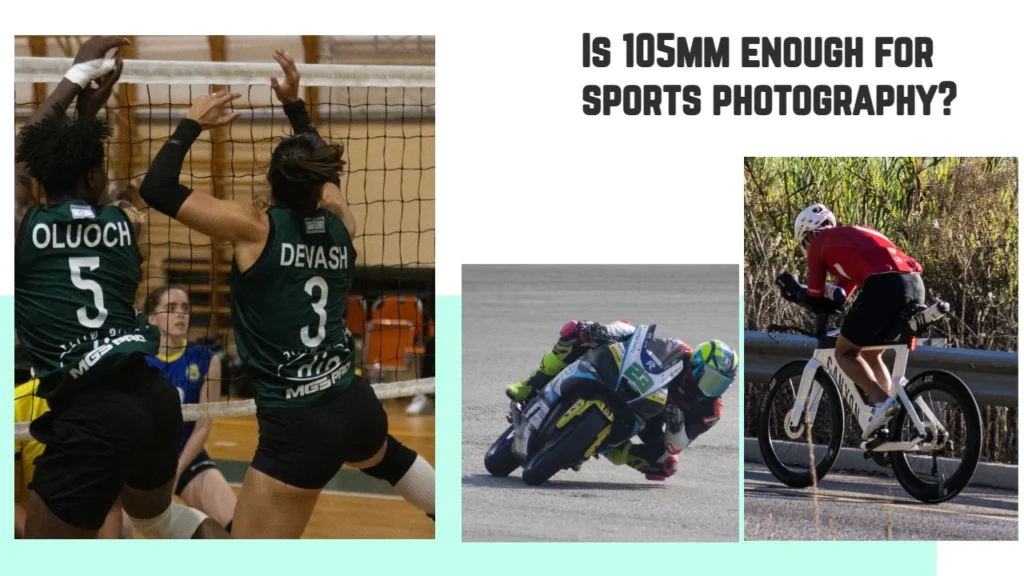
I’m an amateur photographer, not a professional sports photographer or a camera equipment reviewer. The observations and comparisons in this article are based primarily on my own photography experience, including photographing sports such as handball and motocross, together with my practical experience using different lenses and camera settings.
Your results may be different depending on your camera, lens, shooting position, lighting conditions, photography style and level of experience. Think of this article as a real-world photographer’s perspective, rather than a laboratory test or professional equipment review.
My goal is simple: to share what I have learned from actually taking photographs and help other photographers make more informed choices about their equipment.
What to Look for in a Telephoto Lens for Canon R7
-
Effective Focal Length and APS-C Crop Factor
-
Aperture vs ISO Performance
-
Image Stabilization and Handheld Shooting
-
Weight, Balance, and Long Shooting Sessions
| Feature / Category | EOS R7 + RF-S Lenses (e.g., 18-150mm) | EOS R7 + EF 70-300mm Lenses (with Adapter) |
|---|---|---|
| Autofocus Performance |
• Native RF-S communication → fast • Excellent subject tracking • Smooth eye/animal/vehicle AF |
• Very good AF when using Canon adapter • Slightly slower response vs RF native • Reliable for most subjects |
| Reach / Telephoto Capability |
• Limited reach (~18-150mm → ~29-240mm eq) • Not ideal for distant wildlife or sports |
• More telephoto reach (~70-300mm → ~112-480mm eq) • Better for birds, tennis, motorsports |
| Size & Weight |
• Lightweight and compact • Ideal for travel / everyday shooting |
• Bulkier & heavier (lens + adapter) • More demanding to carry long sessions |
| Image Quality |
• Very good overall optical performance at mid-range • Slight softness at extreme tele end |
• Good sharpness throughout zoom range • Telephoto magnification can start to show softness on cheap models |
| Aperture & Low-Light |
• Variable aperture (e.g., f/3.5-6.3) • Less ideal in low light |
• Often variable aperture (e.g., f/4-5.6 or f/4.5-5.6) • Similar low-light limits to RF-S zooms |
| Stabilization |
• Lens + R7 in-body stabilization work well • Strong performance handheld |
• Depends on lens’s IS quality • Still benefits from R7 IBIS |
| Compatibility & Workflow |
• Native support — no adapter needed • Smaller kit, fewer parts |
• Requires EF-to-RF adapter • Adds linkage and slight workflow complexity |
| Cost |
• Often cheaper overall kit • Great value for general use |
• EF lenses + adapter → higher upfront • Used EF glass can mitigate cost |
| Ideal Use Cases |
• Everyday / travel / walkaround • Street / family / landscapes |
• Wildlife / birds at moderate distance • Field sports / weight outdoor action |
| Overall Strength |
• Extremely versatile general lens • Light kit, strong AF, great all-around |
• Better reach and telephoto utility • Slight trade-off in AF speed & size |
Capturing Action: Sports Photography for Active Seniors
Photography isn't just a quiet, stationary hobby—it can be a dynamic, physical pursuit that blends creative passion with outdoor movement. Combining sports photography with senior fitness activities creates a powerful opportunity to stay active, sharpen reflexes, and celebrate active lifestyles behind the lens.
1. Active Movement & Vitality
Pacing the sidelines at a grandchild’s football game, tracking a fast-paced pickleball match, or hiking to get the best angle at an amateur cycling event provides excellent low-impact cardiovascular exercise. Incorporating physical movement alongside technical shooting is one of the most rewarding wellness tips for seniors who want to stay fit while having fun.
2. All-Season Outdoor Shooting
Staying active outdoors shouldn't stop when temperatures drop. Action photography adapts wonderfully to seasonal sports like brisk winter walking, speed skating, or snowshoeing meets. Combining high shutter speeds with cold-weather gear turns winter outings into creative adventures—making it a fantastic fit for outdoor winter activities for seniors.
3. Mastering the Craft & Gear
Freezing high-speed motion requires mastering burst mode, continuous autofocus (AF-C), and panning techniques. Whether using a lightweight mirrorless body, a fast zoom lens, or a sturdy monopod for extra stability, honing these technical skills keeps the mind sharp. Discover in-depth camera guides and shooting tutorials across the photography category on DG2Market.
Sports Photography FAQ: Canon Lenses, Aperture and Focal Length
1. Is f/2.8 or f/4 better for indoor sports?
For sports photography indoors, f/2.8 generally provides an advantage because it lets more light reach the sensor. This can help you use faster shutter speeds and keep moving athletes sharp, particularly in darker gyms or arenas. An f/4 lens can still work very well when lighting is good or when your camera performs well at higher ISO settings. The choice therefore depends on the venue, available light and your preferred shutter speed.
2. Is 105mm enough for sports photography?
It depends on how far you are from the action. A 105mm focal length can be very useful for indoor sports, local competitions and situations where athletes are relatively close. However, for outdoor sports where the action is far away, 105mm may not provide enough reach. In those situations, a longer telephoto lens such as a 70-200mm or 100-400mm may be more practical.
3. What focal length is best for indoor sports photography?
There is no single focal length that works for every indoor venue. A range around 24-70mm is useful when you are close to the action, while 70-105mm can help when you are farther away. For sports photography in larger indoor arenas, a 70-200mm lens can provide additional reach. Your position beside the court or field is often just as important as the lens itself.
4. What is the best Canon lens for handball photography?
For handball photography, a fast zoom such as a 24-70mm f/2.8 can be particularly useful when photographing close action from the sideline. A 70-200mm f/2.8 can be more suitable when you need greater reach. The choice depends on your shooting position, the size of the venue and lighting conditions. There is no single Canon lens that is ideal for every handball situation.
5. What is the best lens for sports photography on Canon R7?
The best lens depends on the sport and shooting distance. On the Canon R7, an APS-C camera, lenses such as a 24-70mm or 24-105mm provide useful general-purpose ranges, while a 70-200mm or longer telephoto lens provides more reach. For indoor sports, an f/2.8 lens can be particularly useful because it allows more light to reach the sensor.
6. 24-70mm or 24-105mm for Canon R7?
The 24-70mm f/2.8 prioritizes a faster aperture, while the 24-105mm f/4 provides additional reach and versatility. On the Canon R7, the 105mm end can be useful for framing action farther away. For indoor sports photography, however, the f/2.8 aperture of the 24-70mm can make it easier to maintain a fast shutter speed.
7. Can you use a 24-105mm lens for indoor sports?
Yes. A 24-105mm lens can be very useful for indoor sports when the lighting is reasonably good and you need flexibility between wide and tighter compositions. The 105mm reach can help when you cannot move closer to the athletes. In darker venues, however, an f/2.8 lens may provide an advantage over an f/4 lens for maintaining faster shutter speeds.
8. Why is f/2.8 better for sports photography?
An f/2.8 aperture allows more light into the camera than f/4. This can be particularly useful for sports photography because fast-moving athletes often require fast shutter speeds. The extra light can allow you to maintain a faster shutter speed at the same ISO, or use a lower ISO at the same shutter speed. It can also produce more background separation.
9. What shutter speed should I use for sports photography?
A shutter speed of around 1/1000 second is a useful starting point for many fast sports, although the appropriate setting depends on the movement. Around 1/500 second may work for slower action, while very fast subjects may benefit from 1/1600 second or faster. Check your images and adjust according to the sport, lighting and desired amount of motion blur.
10. Is 70mm enough for sports photography?
70mm can be enough when you are close to the action, particularly for indoor sports such as handball or basketball. It is also useful for environmental sports photographs showing the athlete and surroundings. However, 70mm can feel short when photographing action from the stands or across a large field. In those situations, a longer lens can provide more useful framing options.
11. Is 105mm enough for motocross photography?
105mm can work well when you are relatively close to the track, especially for environmental images and riders passing nearby. For distant motocross action, however, more reach is usually helpful. A 70-200mm, 100-400mm or similar telephoto range can give you greater flexibility while keeping a safe distance from the track.
12. What Canon lens is best for handball?
For handball, consider both aperture and focal length. A 24-70mm f/2.8 can be a strong option when you photograph close to the court and need good low-light performance. A 70-200mm f/2.8 can be useful when you need more reach. A 24-105mm f/4 offers versatility, particularly in well-lit venues. Your shooting position should guide the final choice.
13. Is image stabilization important for sports photography?
Image stabilization can help reduce camera shake, particularly when using longer focal lengths, but it does not freeze a moving athlete. For sports photography, shutter speed remains critical. Autofocus performance, aperture, ISO capability and your shooting technique can all have a greater effect on the sharpness of fast-moving subjects.
14. Should I choose a zoom or prime lens for sports photography?
A zoom lens provides flexibility when athletes move toward or away from you, which can be extremely useful for sports photography. A fast prime lens can provide a wide aperture and excellent low-light performance but gives you a fixed focal length. For many amateur sports photographers, a versatile zoom can be easier to use because the framing can be changed without changing position.
Final note: This comparison reflects my personal experience and opinions as an amateur photographer. Lens performance can vary considerably depending on the camera body, lighting, shooting distance and individual shooting technique. Always consider your own photography needs before choosing equipment.





One Comment